Tuesday, February 8, 2022

Genesis 6-11, Moses 8

NEXT WEEK 

Genesis 12-17, Abraham 1-2


MICVAH

https://m.youtube.com/watch?v=PGfvqBl-3Ao


PERSPECTIVE

“It's interesting because I do think that in the past, we've taken a very literal approach to the Bible. And that was considered the only faith-based approach. And now today, we've started to realize that there are many faith-based approaches to the Bible. Just even talking about the Flood, for example, you can believe in a global universal Flood that was a miracle, and that's fine. You can believe that it was more of a regional Flood.

So when they talk about the world or the earth, they're talking about their world, the world that they knew. And there's evidence of flood deposits in Mesopotamia and other places. And that's also a faith-based approach. And this is going back to this idea of being open minded about things.

I love that we can accept different points of view, even though I think we struggle with that. We want a nice tidy package. We want, ‘This means this and it can mean nothing else.’ But that's not how scripture works, that's not necessarily how these things work.

Dr. Krystal L. Pierce, Follow Him Podcast


SONS OF GOD

“[Moses gives a] little more information. Noah was considered a son of God because he listened to God, and his daughters were daughters of God because they listened to God. But the problem was they married those who weren't listening to God, the sons of men. And so once they married them their behavior changed. They were influenced by them. They were affected by them. And then they changed from daughters of God to daughters of men at that point. So it's just a way of talking about somebody's being, really honestly, righteous or wicked.”

Dr. Krystal L. Pierce, Follow Him Podcast


“REPENTED”

“There's something a little bit different going on here, and this word that's translated as repent here is the Hebrew word nacham.

Naham is such a great word because it appears all over the Old Testament. And every time it appears, it's translated in a different way. So people struggle with its meaning. And actually what's great is this word shows up in the Book of Mormon too as the place where Ishmael was buried on the way to the promised land, he was buried at Naham. Half of this word means grieving, sadness, mourning, being in pain. But the other side of nachum, and this is why people struggle with it because it almost seems like the opposite, it also means to be comforted. It also means to be consoled. It also means to feel content. I think people struggle because they say, "How can you feel sadness and comfort at the same time? How can you be mourning, but also feel consoled?"

Dr. Krystal L. Pierce, Follow Him Podcast


 TSOHAR

“There's this Jewish rabbinical tradition that, when God created Adam, one of the things he did was he put his light; God's light in a stone, so that Adam would always have the light of God with him. And Adam passed this stone down. He passed it down until it got to Noah. And the tradition goes that Noah used it to light the Ark. And so the tsohar was actually this lighted stone that Noah had. And then the tradition continues. He passed it down. It eventually went to Moses, who used it to light the tabernacle, so that there was always this light of God with the prophets and being passed down.”

Dr. Krystal L. Pierce, Follow Him Podcast


 NOAH AND THE ARK

“If we fancy Noah riding the sunny seas high, dry and snug in the Ark, we have not read the record—the long, hopeless struggle against entrenched mass resistance to his preaching, the deepening gloom and desperation of the year leading up to the final debacle, then the unleashed forces of nature, with the family absolutely terrified, weeping and praying ‘because they were at the gates of death’ as the Ark was thrown about with the greatest violence by terrible winds and titanic seas...Finally, Noah went forth into a world of utter desolation, as Adam did, to build his altar, call upon God, and try to make a go of it all over again, only to see some his progeny on short order prefer Satan to God and lose all the rewards that his toil and sufferings had put in their reach.”

Hugh Nibley, Scriptures Plus Instagram


 ZIGGURATS

“We actually have about 25 examples of enormous towers in Mesopotamia, and these are called ziggurats. Most biblical scholars believe that the tower of Babel was a ziggurat. They were made out of burnt bricks. That's a good connection. They're basically these towers of narrowing platforms. A big platform on the bottom and it gets narrower to another platform, and another one and another one, all the way up to the top. And these things could be huge, as big as 300 feet on one side, and as tall as 200 feet up in the air.

They were completely filled with rubble, and dirt and sand and things like that. They had this ramp or stairs going up to the top. So we find out in archeology texts, that the reason they build these is first, to make it so that God could come down to earth. If they build it up into heaven it makes it possible for God to be able to use the ramp and the staircase, and come down and visit earth, and go to the temple and be worshiped.

The other purpose was to make it so that God would stay on earth, that he wouldn't go back to heaven. And so on the very top of these ziggurats, there was a bedroom, an empty room, that they built for God. And inside the room was a bed and a table, and the priest would go up and they'd make the bed all nice, and they'd set the table with food and drink. And there was a chair. So their hope was that God would come down. He would live in this tower, so they would reach into heaven, be able to access God, bring him down. They would make a name for themselves, because if God's living in your city, on your ziggurat, then you're going to be famous. This kind of idea, if we can get God to live in our tower, in the ziggurat, then we won't be scattered. We can convince him this is where we need to stay.”

Dr. Krystal L. Pierce, Follow Him Podcast


INSIGHTS FROM THE STORY OF NOAH

What do we learn about the nature of God from the story of Noah and the story of the Tower of Babel?

How did the understanding of God’s nature inform their behaviors and how does it inform ours?`````        

Tuesday, February 1, 2022

Genesis 4-5; Moses 5-7

 NEXT WEEK

Genesis 6-11, Moses 8

ENOCH

“There is no single event or influence in the life of Jospeh Smith that was more transformative and shaping of his future ministry than encountering Enoch as a figure.”

Terryl Givens, BYU Maxwell Institute Podcast

ENOCH’S INFLUENCE ON JOSEPH SMITH

“The Enoch text sowed the seeds of Mormonism’s most distinctive and vibrant doctrines: It produced the most emphatic version of a passible deity the Christian world then knew (a God of passions and emotions). It catalyzed Latter-day Saint understanding of and enthusiasm for the doctrine of premortal existence. It foreshadowed, and might more vitally inform, the church’s distinctive doctrine of theosis or divinization. And perhaps most importantly, it provided Joseph with the distinctive contours of his own prophetic vocation as a builder of Zion. If the Book of Mormon lent Joseph his indispensable aura of prophetic authority, the prophecy of Enoch provided a personal role model to inspire him and a blueprint to direct him.”

Terryl Givens, https://www.terrylgivens.com/talks/2021/5/19/the-prophecy-of-enoch-as-restoration-blueprint

A GOD WHO WEEPS

“Clearly, Enoch, who believed God to be “merciful and kind forever,” did not expect such a being could be moved to the point of distress by the sins of His children. And so a third time he asks, ‘how is it thou canst weep?’ The answer, it turns out, is that God is not exempt from emotional pain. Exempt? On the contrary, God’s pain is as infinite as His love. He weeps because He feels compassion. It is not their wickedness, but their “misery,” not their disobedience, but their “suffering,” that elicits the God of Heaven’s tears. Not until Gethsemane and Golgotha does the scriptural record reveal so unflinchingly the costly investment of God’s love in His people, the price at which He placed His heart upon them. There could be nothing in this universe, or in any possible universe, more perfectly good, absolutely beautiful, worthy of adoration, and deserving of emulation, than this God of love and kindness and vulnerability. That is why a gesture of belief in His direction, a decision to acknowledge His virtues as the paramount qualities of a divided universe, is a response to the best in us, the best and noblest of which the human soul is capable. A God without body or parts is conceivable. But a God without passions would engender in our hearts neither love nor interest. In the vision of Enoch, we find ourselves drawn to a God who prevents all the pain He can, assumes all the suffering He can, and weeps over the misery He can neither prevent nor assume.”

Givens, Terryl; Fiona Givens. The God Who Weeps: How Mormonism Makes Sense of Life 

"Women Wielding Power: How the Women of the Old Testament Teach the Women of the Present Day." 

I keep forgetting to post my granddaughter's article. Grace is remarkable and I'm so grateful for her. Here is the link to the paper, "Women Wielding Power:How the Women of the Old Testament Teach the Women of the Present Day." 

https://mail.google.com/mail/u/0/#inbox/FMfcgzGllVlFGqjGKqRDDgbvLxCpPCpk?projector=1&messagePartId=0.1

Tuesday, January 25, 2022

Genesis 1-3; Moses 2-4; Abraham 4-5

NEXT WEEK 

Genesis 4-5; Moses 5-7

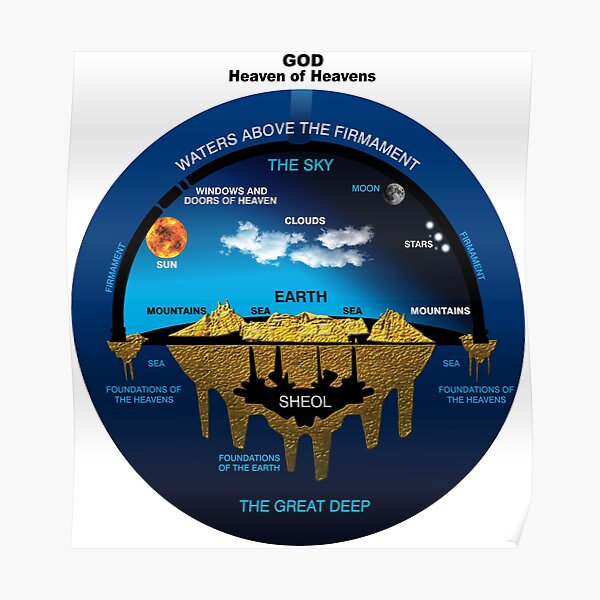
Flat Earth | Ancient Hebrew Cosmology Concept" Poster by VectorDesigner |  Redbubble

GENESIS

The New International Version Study Bible

AUTHOR: Moses           

AUDIENCE: God’s chosen people, the Israelites.

DATE: Between 1446 and 1406 BC

THEME: God creates the world, and after the world falls into sin, he enters into a special relationship with the people through whom he promises to bring redemption.


PURPOSE OF THE CREATION ACCOUNTS

“I think what He's trying to do is explain who He is, what His nature is, explain who people are, our relationship to each other, how do we relate to God and what's our purpose here on earth. Those are the doctrines that Genesis 1 is trying to teach and it succeeds beautifully. It does its job.

For the authors of Genesis, these stories are really written as a prologue to the main story. The one they're really interested in, which is the story of Israel. That's where they're excited to get to. That's why there are so many chapters on Abraham and Sarah, Isaac and Rebecca and Jacob and Rachel, Leah, Bilhah, and Zilpah. That's the real story, is Israel. So all this stuff here for all the attention and the interest that we in the modern world have with these early chapters, they're not spending a lot of time here nor do they go back and talk about it a lot.”

Dr. Joshua Sears, Follow Him Podcast


THE FOUR RIVERS OF EDEN

“I think it's interesting that these rivers are flowing out of Eden and going to these places bringing life and blessedness from Eden out into the world. And maybe it's not a coincidence that these are all places where the Israelites are going to end up enslaved, in captivity, Egypt and Babylon are right there. This is one of many links in these creation stories to the story of the House of Israel later.”

Dr. Joshua Sears, Follow Him Podcast


CREATION OF ADAM AND EVE

Genesis 1:26- 27 Genesis 2: 7, 21-22 Moses 3: 7 and 18, 21-22 Abraham 5: 7, 14-16


ADAM AND EVE

“While the text offers detailed information about the mechanics of Eve's creation, it is silent about what these details signify, particularly as they pertain to the nature and role of Eve. Does Eve's secondary creation, for instance, denote inferiority? Or, does being created last make her the crowning glory of God's creation? Does being formed from man's rib mean the woman is derivative and thus subordinate to him? Or does it indicate a relationship of intimacy and mutuality between the man and the woman?”

The Gospel According to Eve, A History of Women’s Interpretation, Amanda W. Benckhuysen


IMAGE

“What does it mean that man and woman are created in the image and likeness of God? Do the man and the woman image God in rationality, moral sensibility, creativity, dominion, or some combination of these? Do they image God as man and woman together or as individuals? Do they equally bear the image of God or does man image God in a way that woman does not (see 1 Cor 11:7 -12)? And to what extent, if any, was the image of God in human beings lost after Adam and Eve's disobedience? Again, how one answers these questions affects one's understanding of human beings.”

The Gospel According to Eve, A History of Women’s Interpretation, Amanda W. Benckhuysen


HELP MEET

‘Genesis 2:18 says God made for Adam an ezer k’negdo (an phrase which means a helpmate opposite or against him); but the word ezer connotes strength and is usually used in reference to God’s power to help (Psalms 33:20, 70:6, 115:9 and 146:5); so a better understanding of the term is that woman was created to be a parallel helpful force equal to man.”

"The rabbis further taught that the term ezer k’negdo was used to teach that when her husband was right, his wife would be there to support him with her strength.... and when her husband was wrong she would be there with her strength to oppose or restrain him. . . Of course, if a husband does not treat his wife with respect, she may still be his help mate but she will not be his blessing. The Rabbis were cognizant that many husbands disrespected their wives and expounded: “I will make a fitting helper [beside or a restraint] for him”: If he merited, she is a helper; and if not, she should restrain him.’

“Now, isn't that interesting? Part of being a support to one's husband is to oppose him when he is wrong. You try to prevent him from stumbling into the ditch. You don't collude with him in evil, or in laziness, or in hypocrisy. That is actually a deep form of love. That is the way God loves us. God supports us in all our righteous endeavors, and God hedges up our way when we begin to walk amiss.”

V. Hudson, https://www.squaretwo.org/ldcrone/Post12_28_2021.html


AMBIGUITES

1. What was the motive?

2. Who was present when Eve ate the fruit? 

3. Who was given the commandment?

4. Who is to blame?


WHO WAS THERE?

“Rather curiously, Jerome omits from the Vulgate [the Latin translation] the phrase "who was with her" in Genesis 3:6, making Eve doubly culpable for the fall and responsible for Adam's sin. By implying Adam's absence during the serpent conversation with Eve, the Vulgate portrays Eve as the seduced who becomesthe seducer, beguiling a naive Adam to eat the forbidden fruit".

The Gospel According to Eve, A History of Women’s Interpretation, Amanda W. Benckhuysen

“When the woman saw that the fruit of the tree was good for food and pleasing to the eye, and also desirable for gaining wisdom, she took some and ate it. She also gave some to her husband, who was with her, and he ate it.”

NIV Study Bible, pg. 17, Genesis 3: 6


MOTHER EVE

“We need women who have the courage and vision of our Mother Eve.” 

President Russell M. Nelson, “A Plea to My Sisters, October 2015

Wednesday, January 19, 2022

Moses 1; Abraham 3

NEXT WEEK
Genesis 1-4; Moses 2-5; Abraham 4-5


“All of the other standard works, the New Testament included, are built upon the spiritual history and tradition recorded in the Old Testament. This fact alone merits its study.”
James Ferrell, “The Hidden Christ”


Four Keys to Understanding the Old Testament 
by Dr. Kerry Muhlestein
Follow Him Podcast

1. Recognize that the Old Testament is willing to record warts and all more than any other book of scripture. It is cultural that they are just going to lay it all out there.

2. Culturally they are much more symbol oriented than we are, so they are going to rely on symbols as their primary and most important way of communicating.

3. We need to look for the whole story. The Old Testament teaches more about God’s love and mercy than any other book of scripture.

4. Recognize the importance of the Abrahamic covenant. The covenant is the core central thematic element of the entire book.


Objectives for Our Class Study

1. The Book of Mormon 
2. Women
3. Christ


“The Bible, a product of a patriarchal society, is shaped by the concerns of the men of Israel who were involved in public life. As such, it is a public book, concerned with matters of government, law, ritual, and social behavior. But why, then, does this clearly androcentric text from a patriarchal society have so many stories that revolve around women? And why are there so many memorable women in the Bible? The sheer number of their stories demands an explanation: What are they doing here? Why were they written? Why were they included in this compact text?”

Frymer-Kensky, Tikva. Reading the Women of the Bible


“If everything given of God from the beginning bears record of Christ, then it follows that our understanding on any particular matter is incomplete until we see how it bears record of Christ. So of every scriptural element and story, we should ask, “How does this typify or bear record of the Savior?” When we ask this divine question of every element and story in the Old Testament, the scriptures come alive with redemptive meaning.”

Ferrell, James L.. The Hidden Christ: Beneath the Surface of the Old Testament


“Considerable controversy surrounds the Book of Abraham. Joseph Smith’s interpretations of the three facsimiles have come under scrutiny by Egyptologists, and in 1967 some fragments of the papyri once possessed by Joseph Smith were recovered and published. These papyri fragments were translated and found not to contain the Book of Abraham but Egyptian funerary texts known as the Book of Breathings and the Book of the Dead. The relationship between these papyri fragments and the Book of Abraham is a matter of ongoing study and debate.
Since at least the 1960s, Latter-day Saint scholars have explored the text of the Book of Abraham to see what clues might exist that situate it in a plausible ancient setting. They have also argued for the legitimacy of Joseph Smith’s interpretation of the facsimiles as Egyptological knowledge has progressed. These efforts, in conjunction with ongoing progress in the fields of Egyptology and Near Eastern archaeology, have uncovered numerous points of convergence between the text and the ancient world. Evidence for Joseph Smith’s interpretation of the facsimiles has also come to light. These various lines of evidence do not “prove” the Book of Abraham is true, but they do help us situate the text in a plausible ancient environment, inform how we read the text, and positively impact our evaluation of Joseph Smith’s claims to prophetic inspiration.”
Pearl of Great Price Central, https://www.pearlofgreatpricecentral.org/book-of-abraham/


Abraham 
by Dr. Kerry Muhlestein                                                                                                              Follow Him Podcast

1. There is always an order to spheres in the heavens. There is always something above and something below until you get to Kolob which is the highest.

2. Order is determined by how long a day is.

3. The slower the rotation or the longer the orbit, the higher the order.

4. Kolob is the highest because it has the slowest rotation (1 day = 1000 earth years) and is closest to God.

Friday, January 14, 2022

First Class

Hi All,

It's time! Class for this year will begin on Tuesday, January 18, 9:30-11, Old Gilbert building, Relief Society room. The address is 2424 N. Old Gilbert Rd, Mesa. We will be discussing Abraham 3 and Moses 1. 

Please call or email me if you have any questions. I'm looking forward to being with you again and learning together!

See you Tuesday!